
Where Can I Buy NAD+ 500mg?
Researchers looking for NAD+ 500mg for laboratory research can purchase it from Neuro Peptides. NAD+,
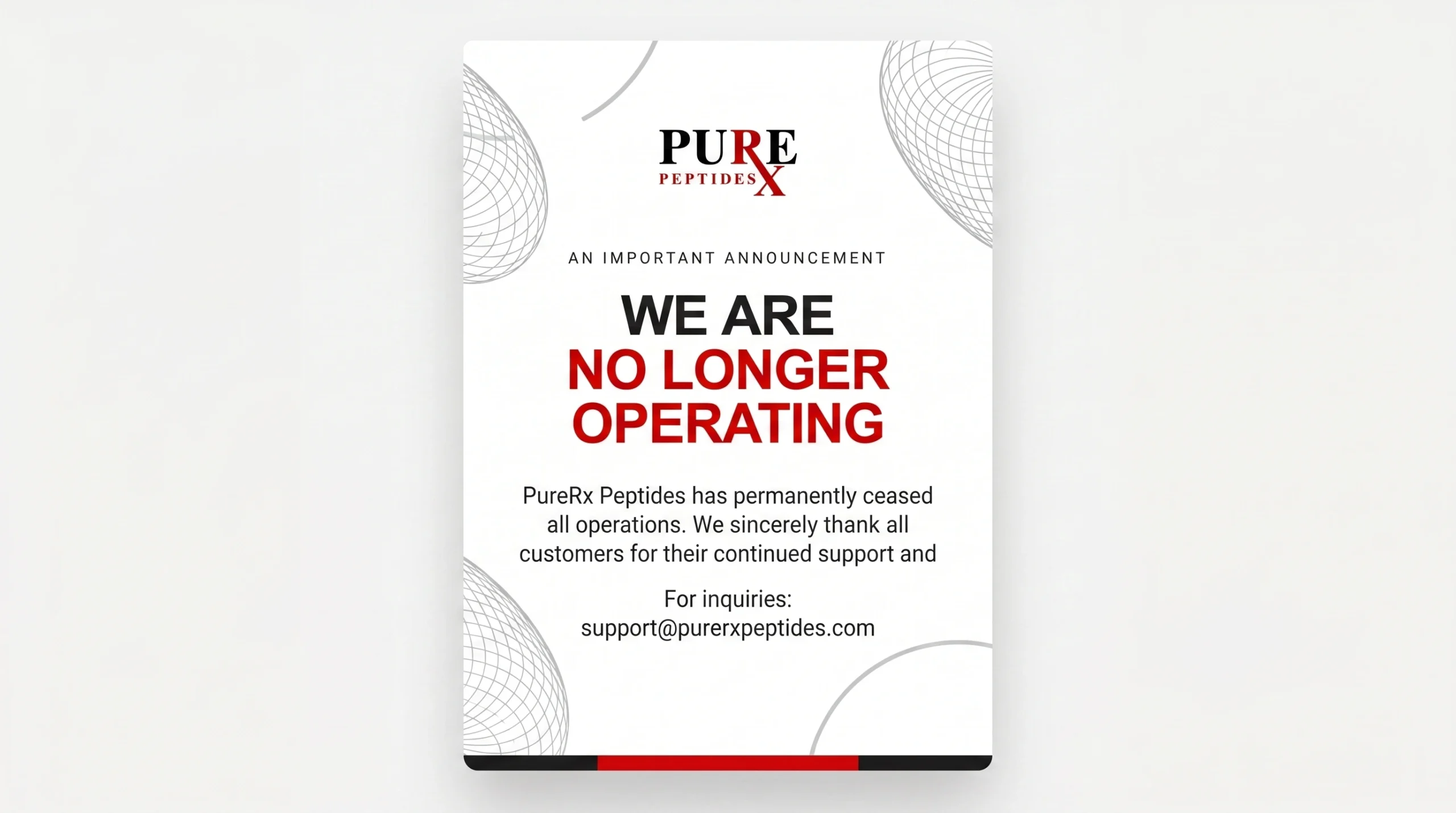
If you recently tried to visit PureRx Peptides and could not access the website, you may be wondering what happened.
For some users, the website may not be accessible at all, while others may see a static screen stating:
” We are no longer operating”. PureRx Peptides has permanently ceased operations. We sincerely thank all our customers for their continued support and trust”
This means that the journey of PureRx Peptides has come to an end.
The research peptide market is facing more regulatory attention in 2026. The U.S. Food and Drug Administration (FDA) has taken action against several online peptide sellers. At the same time, pharmaceutical companies are taking legal action against businesses accused of selling unapproved peptide drugs.
These changes are making the market more difficult for some suppliers.
For researchers who need another supplier, Neuro Peptides is one alternative to consider. Neuro Peptides provides research-use-only peptides and related laboratory products through its online catalog. Researchers can review the available products and documentation before deciding whether the supplier fits their research needs.
But what is happening in the peptide market, and could these changes be connected to the problems faced by some online suppliers?
Let’s look at the situation.
Yes, based on the information currently available on their homepage, it appears that PureRx Peptides has permanently ceased operations and is no longer available to supply research peptides. However, the need for research does not stop.
Researchers who previously relied on PureRx Peptides can now explore Neuro Peptides as an alternative source for research peptides at competitive prices. To receive an additional 10% discount, former PureRx customers can use the coupon code PURERX10 at checkout.
The peptide industry has changed quickly.
Peptides have become popular in research, drug development, and the wider health market. This has brought more attention from regulators, pharmaceutical companies, payment companies, and other parts of the supply chain.
The FDA has been paying particular attention to websites that market unapproved drugs to consumers.
In March 2026, the FDA announced warning letters to telehealth companies over false or misleading claims involving compounded GLP-1 products.
The agency has also sent warning letters directly to peptide businesses.
These actions show why peptide companies are paying much closer attention to how products are described, marketed, and sold.
The regulatory situation is not completely one-sided.
The FDA has also been reviewing the status of several peptides used in compounding discussions.
On July 23 and 24, 2026, the Pharmacy Compounding Advisory Committee discussed several peptide substances, including BPC-157, KPV, TB-500, MOTS-C, DSIP, Semax, and Epitalon.
The committee’s recommendations do not automatically mean that these substances become FDA-approved drugs.
Instead, the process is part of a larger discussion about whether certain substances should be available for use in pharmacy compounding under specific rules.
This creates a complicated situation for the peptide industry.
Some substances are receiving more regulatory attention, while the rules surrounding others are still being reviewed.
One of the biggest recent developments came from Eli Lilly.
On August 12, 2026, Eli Lilly filed six lawsuits against U.S. companies that it accused of selling unauthorized versions of retatrutide.
The companies named in the lawsuits include Aesthetic Envy, Astra, Legendary Peptides, Striker Pharmacy, Texas Peptides, and Lone Star Peptide Co.
This is important because retatrutide is still an investigational drug.
It has not been approved for human use by the FDA. Lilly is still developing the drug and has reported positive results from its clinical trials.
Lilly alleges that some businesses were selling retatrutide to consumers while using “research use only” language.
The lawsuits therefore highlight an important issue in the peptide market:
The words used on a product page do not necessarily determine how regulators view the actual marketing of a product.
How a product is promoted and who it is marketed to can also matter.
The recent Lilly action is also important because the company has asked other companies to help stop unauthorized sales.
According to reports, Lilly has called on social media platforms, payment processors, credit-card companies, and shipping companies to take action against illegal retatrutide sales.
This shows how a regulatory or legal problem can affect more than the company selling the product.
A peptide business depends on several outside services.
For example, it may need:
If one of these services becomes unavailable, a business can experience major disruption even if its website itself is still online.
Payment processing is another issue that peptide businesses need to consider.
Research-use-only peptide companies operate in a category that many traditional financial services providers treat as high risk. Specialized payment providers now advertise services specifically for peptide merchants, which shows that ordinary payment processing can be difficult for this type of business.
Recent legal pressure makes this issue even more important.
When a major pharmaceutical company asks payment processors and card companies to block unauthorized peptide sales, payment infrastructure becomes part of the wider enforcement discussion.
This does not mean that every peptide company losing payment access has been targeted by regulators.
Payment problems can happen for many reasons.
But for an online research supplier, losing a payment processor can quickly affect the ability to accept new orders.
It is possible to identify several pressures facing the peptide industry.
However, it would be wrong to say that PureRx Peptides stopped operating because of the FDA or Eli Lilly without evidence.
There is currently no reliable public statement confirming that connection.
The safest conclusion is that PureRx Peptides is currently unavailable, while the wider research peptide market is experiencing increased regulatory, legal, and commercial pressure.
The two events may be related, but there is not enough public information to establish a direct connection.
When a supplier becomes unavailable, researchers should not choose another company based only on price.
A good research supplier should provide clear information about its products and business practices.
Here are some things to review.
The supplier should clearly explain the intended use of its products.
Research peptides should not be presented as approved medicines or as products for treating medical conditions.
Look for clear product pages.
The page should provide basic information about the compound, formulation, quantity, and intended research use.
Researchers may also want access to analytical documentation such as certificates of analysis or other laboratory documentation.
These documents can provide useful information when evaluating a research material.
A professional website should have clear shipping, refund, privacy, and ordering policies.
This is especially important when purchasing laboratory materials online.
A supplier should make it easy to contact the company.
Researchers may need help with product questions, order information, shipping, or documentation.
A supplier focused on research materials should keep its website and marketing centered on laboratory research rather than making medical promises.
This distinction has become increasingly important as regulators pay closer attention to online peptide marketing.
For researchers searching for a PureRx Peptides alternative, Neuro Peptides is one option to consider.
Neuro Peptides provides a range of research-use-only peptides and laboratory products through its online catalog.
The company focuses on research materials rather than presenting these products as approved treatments.
Researchers can review the available catalog, product information, and documentation before placing an order.
This can be useful for researchers who previously relied on another supplier and now need to evaluate a different source.
Interest in peptides has grown rapidly.
Peptides are being studied across many areas of biological and pharmaceutical research. Researchers are investigating peptide structures, receptor activity, signaling pathways, metabolism, drug delivery, and many other areas.
At the same time, several peptide-based medicines have become major areas of pharmaceutical development.
This has increased public interest in compounds such as GLP-1-related peptides.
Retatrutide is a good example.
The compound is still being studied by Eli Lilly, but its clinical results have created significant interest. Lilly has said it plans to submit retatrutide for regulatory review after completing its development program.
That interest has also created problems.
Some companies have attempted to sell unapproved versions directly to consumers, which has attracted regulatory and legal attention.
For legitimate research suppliers, this makes clear product positioning and responsible marketing more important than ever.
The peptide industry is likely to remain under close observation.
There are several reasons for this.
First, demand for peptide-related products continues to grow.
Second, pharmaceutical companies have large commercial interests in peptide-based medicines.
Third, regulators are examining how certain peptides are manufactured, compounded, marketed, and distributed.
Fourth, recent lawsuits show that pharmaceutical companies are willing to take legal action against businesses they believe are selling unauthorized versions of their products.
This does not mean that all research peptide suppliers will disappear.
It does mean that the market is likely to become more selective.
Companies that clearly separate laboratory research materials from medical products may be better positioned to operate in this changing environment.
So, what happened to PureRx Peptides?
At present, the most accurate answer is that the PureRx Peptides website is unavailable, but the exact reason for the interruption has not been publicly confirmed.
There is no good reason to claim that the FDA, Eli Lilly, or a payment processor specifically caused PureRx to stop operating without direct evidence.
However, the wider peptide market is clearly facing more pressure.
The FDA has issued multiple warning letters involving peptide sellers and online marketing. Its advisory committee is also reviewing several peptides and their potential role in compounding.
At the same time, Eli Lilly has filed six lawsuits over alleged unauthorized retatrutide sales and has asked payment companies, shipping services, and online platforms to help stop illegal sales.
For researchers, this makes supplier selection more important.
If PureRx Peptides is no longer available for your research needs, Neuro Peptides is an alternative worth reviewing. Researchers can explore its research-use-only catalog and evaluate individual products based on their own laboratory requirements.
The key is to choose a supplier that provides clear product information, appropriate research-use language, accessible documentation, and transparent business practices.
About the Author
Dr. Ethan Morgan
Neuroscience & Peptide Research Specialist · Medical Author at Neuro Peptides
Dr. Ethan Morgan is a Neuroscience & Peptide Research Specialist and medical author for Neuro Peptides. He has more than 10 years of experience in scientific research, medical education, and evidence-based content.
Areas of Focus
This article has been medically and factually reviewed by Dr. Ethan Morgan to ensure accuracy, clinical relevance, and alignment with current scientific literature.
Researchers looking for NAD+ 500mg for laboratory research can purchase it from Neuro Peptides. NAD+,
Mitochondria have long been understood as essential sites of cell energy production; however, accumulating evidence
Researchers looking for Retatrutide 10mg for laboratory research can find this research compound at NeuroPeptides.
MOTS-C is a 16-amino-acid mitochondrial-derived peptide (MDP) that has attracted growing interest in research on
MOTS-C is a mitochondrial-derived peptide (MDP) that has been extensively investigated in the context of
MOTS-C is one of the latest mitochondrial-derived research peptides being investigated with growing interest in