
Where Can I Buy NAD+ 500mg?
Researchers looking for NAD+ 500mg for laboratory research can purchase it from Neuro Peptides. NAD+,
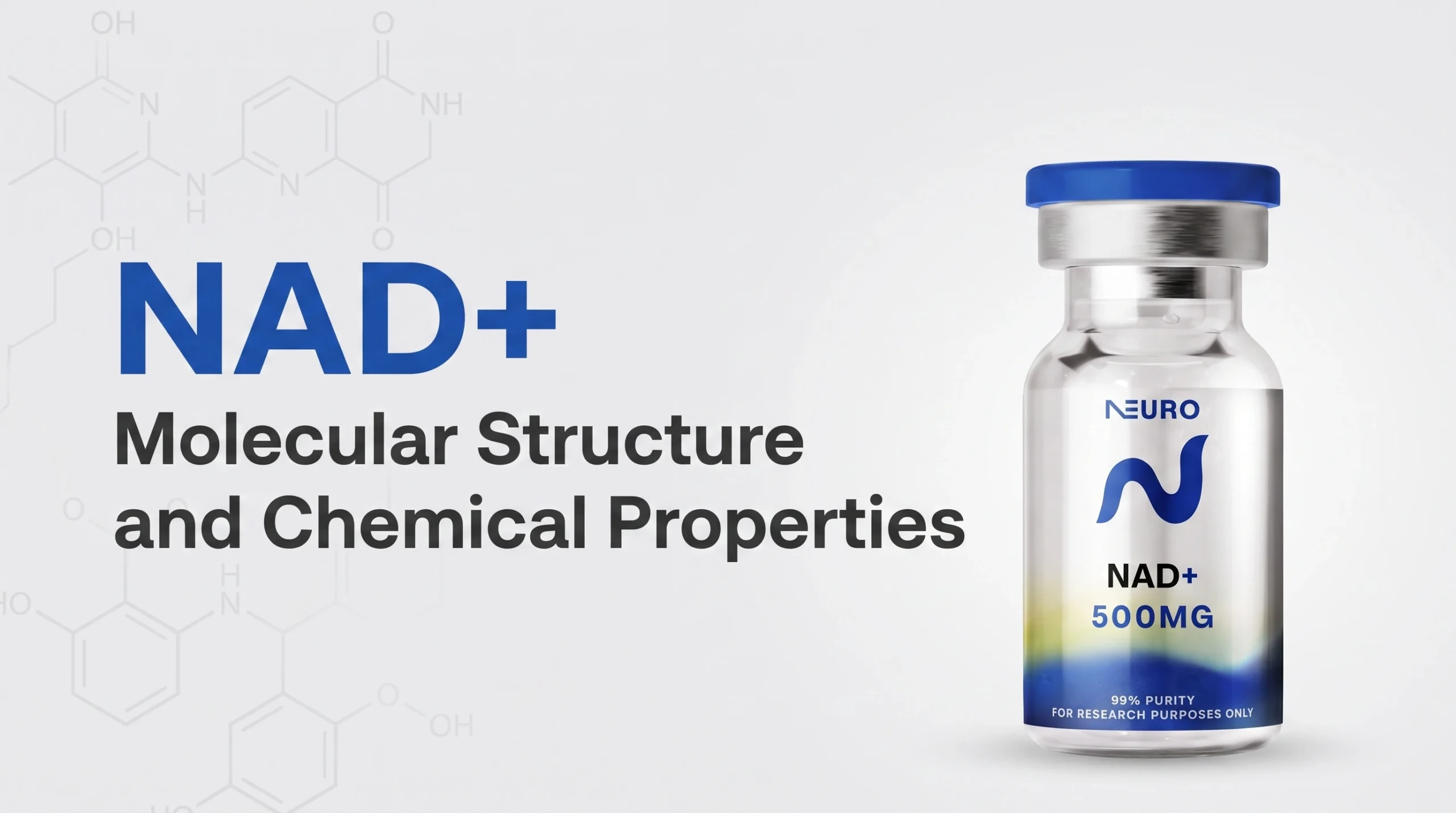
Nicotinamide adenine dinucleotide (NAD+) is a chemically sophisticated dinucleotide coenzyme present in biological cells. This compound gains significance due to its structural and chemical composition that enables participation in reversible redox reactions as well as acting as a substrate for a variety of NAD+-dependent enzymes.
At a molecular level, this dinucleotide coenzyme consists of an adenine nucleotide component and a nicotinamide nucleotide component linked by a pyrophosphate bond.
In this case, the oxidized NAD+ molecule is characterized by a net charge, while the actual ionic state depends on the way the molecule is represented chemically. According to the ChEBI database, NAD+ is an oxidized form of nicotinamide adenine dinucleotide with a formula of C₂₁H₂₈N₇O₁₄P₂ having a net charge of +1 and an average mass of 664.438 Da.
This understanding of the structure of NAD+ is critical because this molecule cannot be simply referred to as an “energy molecule.”
Researchers can now buy NAD+ 500 mg at Neuro Peptides at affordable prices.
NAD+ is a dinucleotide, which implies that it consists of two nucleotide-derived components. While one component contains adenine, the other contains nicotinamide. The two components are joined by the phosphates using a 5′-5′ pyrophosphate bond.
The main structural components of NAD+ include:
| Structural component | Chemical role |
| Nicotinamide ring | Redox-active center involved in hydride transfer |
| Adenine | Contributes to molecular recognition and enzyme binding |
| Two ribose sugars | Provide the carbohydrate framework of the dinucleotide |
| Phosphate groups | Connect the nucleotide units and contribute strongly to polarity and ionic character |
| Pyrophosphate linkage | Joins the two nucleotide-derived portions |
The nicotinamide portion is the chemically active part of NAD, and the adenine portion plays a significant role in the binding of NAD+ to proteins that can bind to NAD+. The importance of the structure and intermolecular interactions of NAD has been known from structural studies on NAD for a long time. In 1976, Rossmann described the structure of NAD and its interaction with proteins.
As far as the chemical formula is concerned, the formula that has been used by some sources for the positively charged NAD+ is C₂₁H₂₈N₇O₁₄P₂⁺ , and the average molecular weight is about 664.4 g/mol. According to the ChEBI database, the molecular formula is C₂₁H₂₈N₇O₁₄P₂.
| Property | NAD+ |
| Chemical name | Nicotinamide adenine dinucleotide |
| Abbreviation | NAD+ |
| Molecular formula | C₂₁H₂₈N₇O₁₄P₂⁺ |
| Average molecular mass | 664.4 g/mol |
| Monoisotopic mass | 664.116 Da |
| CAS number | 53-84-9 |
| Chemical class | Dinucleotide coenzyme |
| Redox counterpart | NADH |
| Redox-active region | Nicotinamide ring |
It is necessary to differentiate the charged NAD+ form from other database representations such as NAD zwitterions or neutralized forms. For instance, differences in molecular weight such as 663 versus 664 Da may arise due to the chemical form represented rather than another biological compound. ChEBI defines NAD+ as the conjugate acid of the NAD zwitterion.
NAD+ is characterized by the presence of a nicotinamide pyridinium ring, which harbors the nitrogen atom that contributes to the overall positive charge of the molecule and serves as the center for hydride transfer reactions.
In a typical reduction-oxidation reaction, NAD+ accepts a hydride equivalent at the fourth carbon atom of the nicotinamide ring, forming NADH. This alters the electron arrangement in the ring, thus changing the oxidized form of the coenzyme into its reduced form.
This process may be described as:
NAD+ + H⁻ → NADH
During enzymatic processes, the transfer of a hydride takes place either from the substrate to NAD+ or from NADH to the substrate. The reversibility makes the NAD+/NADH couple capable of being an efficient carrier of reducing power.
Studies analyzing the molecules of NAD+ and NADH at a molecular level reveal that there are structural and electronic state differences between the molecules that affect their chemical properties. In their study on the subject, Molano-Arevalo et al. (2018) employed ion mobility mass spectrometry, infrared spectroscopy, and molecular dynamics analysis.
NAD+ chemical properties depend on its nicotinamide pyridine ring, which exhibits reversible hydride transfer in the process of changing the oxidized and reduced forms. The environment of NAD+ and the shape of the molecule itself can affect the way the molecule interacts with proteins and other cellular components. Migaud et al. (2024) discussed NAD+ and NADH chemistry, compartmentation, and metabolism.
The two parts of NAD+ derived from nucleotides are linked via a pyrophosphate bond. The chemical significance of this linkage lies in the fact that it binds the adenine and the nicotinamide parts within one molecule, in addition to making the NAD+ molecule highly polar.
NAD+ molecule has many oxygen atoms bound to phosphate and hydroxyl groups. This gives many opportunities for hydrogen bonding and electrostatic interactions with proteins. This makes the NAD+ molecule highly hydrophilic and suitable for functioning in aqueous cellular medium.
The phosphate backbone of NAD+ also serves in recognition by enzymes. The binding of NAD+ molecules to proteins occurs through hydrogen bonding, electrostatic interactions, and other kinds of interactions.
The physicochemical characteristics of NAD+ are considerably affected by the presence of a multitude of oxygen- and nitrogen-containing groups in the molecule.
It consists of:
All this imparts a highly polar character to NAD+ and makes it rather difficult for the compound to be lipid-soluble. ChEBI provides a structure of NAD+, thus showing its extensive oxygen- and nitrogen-containing nature.
The polarity is also significant for cell membrane physiology because NAD+ is highly charged and does not readily diffuse across lipid bilayers.
Even though NAD+ has a definite chemical structure, it is not a fully rigid molecule.
The linkages in different parts of the molecule give it the possibility to have various conformations. Studies on molecular dynamics have demonstrated that NAD+ can move from one folded conformation to another in solution. It was found by Smith (1999) that folded conformations of NAD+ are preferred in solution, as folding leads to decreased solvent accessible surface area and changes in interactions with the rings of nicotinamide and adenine.
More recent studies on spectroscopy and computational approaches have also revealed that there are open, stacked, and closed conformations of NAD+ and NADH. Thus, these data show that NAD+ is a dynamic molecule and not a totally rigid one.
Conformational flexibility can play an important role in the interaction of NAD+ with various enzymes.
While NAD+ and NADH molecules possess almost identical molecular structure, the distinguishing characteristic between the two is the difference in oxidation status of the nicotinamide group.
In particular, while NAD+ represents an oxidized molecule, NADH is a reduced one. The reduction reaction involves the addition of reducing equivalents to the nicotinamide group rather than the complete structural transformation of the molecule.
Such a relatively simple chemical reaction makes the NAD+/NADH pair important for metabolic processes in the cell, where NAD+ receives reducing equivalents in oxidation reactions of different molecules, and NADH is able to transfer them to other biological reactions, such as oxidative phosphorylation in mitochondria.
NAD+ is analogous to NADP+ (nicotinamide adenine dinucleotide phosphate). The structural difference between these two molecules is that both are dinucleotides, but NADP+ has an extra phosphate molecule.
This structural difference leads to differences in enzymatic activity and different cofactor pools being produced in the cell. NAD+ is generally associated with oxidative catabolic reactions, whereas NADPH is commonly used as a reducing cofactor in anabolic and antioxidant reactions.
The above comparison underscores the principle of biochemical chemistry, which states that even minor changes in molecular structure can lead to functional differences in the molecule.
However, NAD+ is not limited to its function in electron transfer only.
NAD+ may act as a substrate for multiple enzymatic systems such as sirtuins, PARPs, and CD38. These enzymes cleave or metabolize NAD+ during their participation in reactions that contribute to protein modifications, DNA damage responses, and cellular signaling.
Thus, NAD+ acquires two roles in cellular biochemistry: one is related to NAD+ as a redox coenzyme responsible for the process of electron transfer reversibly, and another is related to NAD+ as a substrate of NAD+-consuming reactions. Covarrubias et al. (2021) described those additional roles in the review of NAD+ metabolism.
The final determinant in the activity of NAD+ lies in how NAD+ binds with proteins.
Various enzymes recognize different parts of the molecule, and the adenine-containing part, the ribose-phosphate backbone, and the nicotinamide ring can all participate in enzyme binding and orientation.
Thus, the three-dimensional structure becomes as crucial as the chemical formula. The NAD+-consuming enzymes need to orient NAD+ in such a way that a cleavage or modification takes place, while the hydride transfer enzymes need to orient NAD+ in such a manner that the nicotinamide C4 carbon is properly positioned.
The characterization of NAD+ is possible via many types of analysis.
Mass spectrometry can detect the molecular weight and give data on the molecular identity, while HPLC and other chromatographic techniques can purify NAD+ from other nucleotides and metabolites. The spectroscopic methods can differentiate between NAD+ and NADH due to their different electronic structure and optical and vibrational properties.
Ion-mobility mass spectrometry and molecular modeling are some of the advanced techniques that have been employed for the study of NAD+ conformational structures. Molano-Arevalo et al. (2018) provided an example of the application of experimental and computational methods in NAD+ structure studies.
The positively charged NAD+ compound is written as C₂₁H₂₈N₇O₁₄P₂⁺, which has a mean molecular weight of about 664.4 g/mol.
The nicotinamide pyridinium ring acts as the site of the redox reactions in NAD+/NADH cycling by hydride transfer at the fourth carbon position in this ring.
Rather than being a nucleotide, NAD+ is actually a dinucleotide coenzyme, as it consists of two parts derived from the nucleotides.
NAD+ is a polar molecule due to the presence of several phosphate, hydroxyl, amino, and other oxygen-containing functional groups.
NAD+ represents the oxidized form, while NADH stands for the reduced form.
The most characteristic feature of NAD+ is the highly ordered but highly dynamic structure of the molecule that includes adenine, nicotinamide, two ribose sugars, phosphate groups, and a pyrophosphate bond. The chemical composition of the molecule is presented by the chemical formula of C21H28N7O14P2⁺ with the molecular weight of about 664.4 g/mol.
One of the most important chemical properties of NAD+ is the ability of the molecule to perform reversible hydride transfer between NADH and NAD+. Besides, the presence of multiple phosphates provides high polarity of the molecule and interaction with enzymes. Even NAD+ may be used as a substrate for enzymes participating in signaling processes.
Therefore, the molecular structure of NAD+ is responsible for the biological functions of the molecule. Redox-active ring of nicotinamide, pyrophosphate bond, highly polar phosphate backbone, conformational plasticity, and enzyme recognition properties make NAD+ a unique cell molecule.
About the Author
Dr. Ethan Morgan
Neuroscience & Peptide Research Specialist · Medical Author at Neuro Peptides
Dr. Ethan Morgan is a Neuroscience & Peptide Research Specialist and medical author for Neuro Peptides. He has more than 10 years of experience in scientific research, medical education, and evidence-based content.
Areas of Focus
This article has been medically and factually reviewed by Dr. Ethan Morgan to ensure accuracy, clinical relevance, and alignment with current scientific literature.
Researchers looking for NAD+ 500mg for laboratory research can purchase it from Neuro Peptides. NAD+,
Mitochondria have long been understood as essential sites of cell energy production; however, accumulating evidence
Researchers looking for Retatrutide 10mg for laboratory research can find this research compound at NeuroPeptides.
MOTS-C is a 16-amino-acid mitochondrial-derived peptide (MDP) that has attracted growing interest in research on
MOTS-C is a mitochondrial-derived peptide (MDP) that has been extensively investigated in the context of
MOTS-C is one of the latest mitochondrial-derived research peptides being investigated with growing interest in