
Where Can I Buy NAD+ 500mg?
Researchers looking for NAD+ 500mg for laboratory research can purchase it from Neuro Peptides. NAD+,
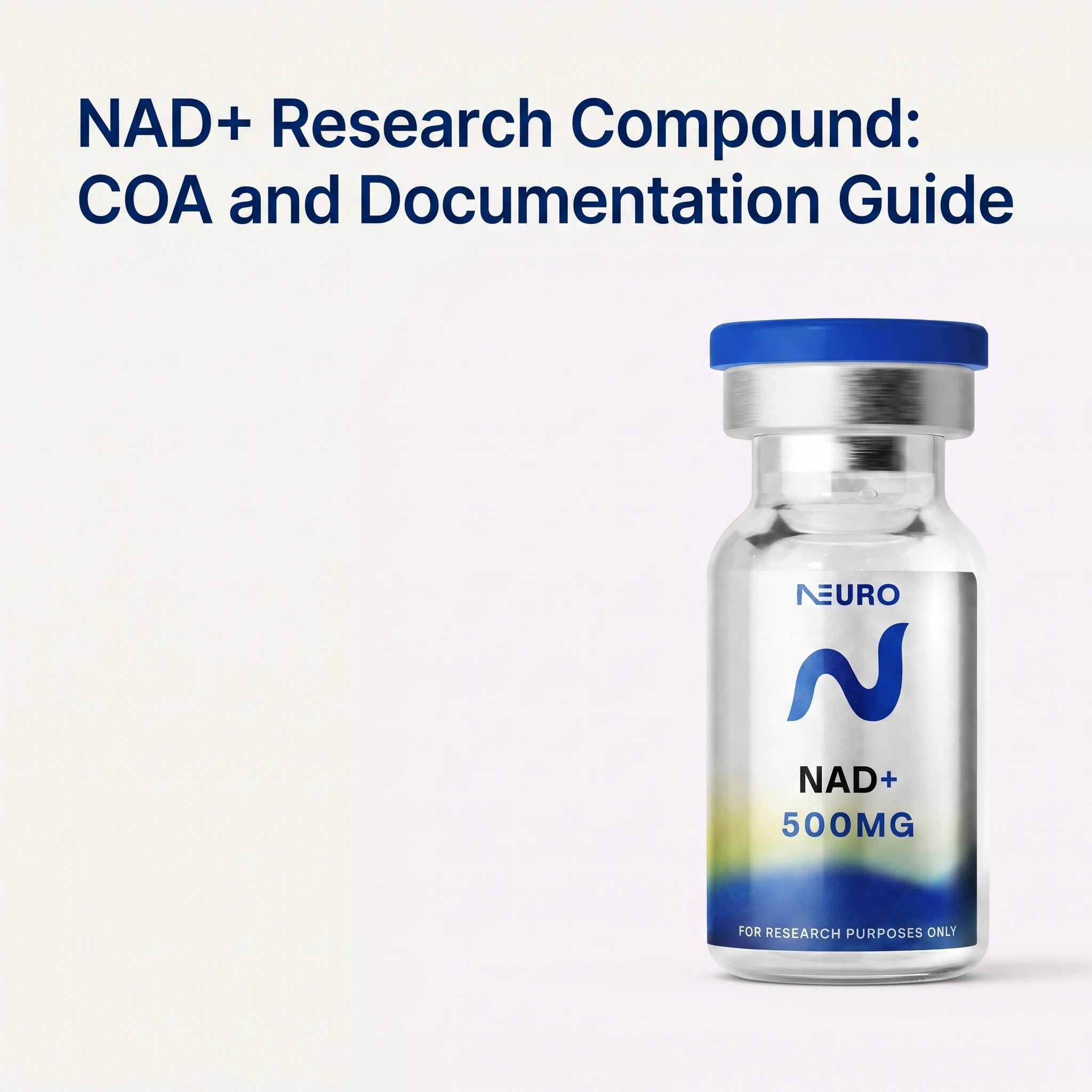
When researchers buy an NAD+ research compound, the product label alone does not provide sufficient information about its analytical quality. A Certificate of Analysis (COA) gives researchers important batch-specific information about the material, including its identity, purity, testing method, and relevant handling details.
This documentation matters because NAD+ is chemically sensitive, and accurate NAD+ analysis can require careful sample preparation and validated analytical methods. Published research has used HPLC and LC-MS/MS to separate, identify, and quantify NAD+ and related metabolites.
A useful COA should therefore answer several basic questions:
For example, HPLC can separate NAD+ from related compounds and quantify it through comparison with a standard curve. LC-MS/MS can provide additional molecular identification by comparing detected ions and fragmentation patterns with an NAD+ reference standard.
This distinction is important because purity and identity are not the same thing. A COA that only states “≥99% purity” gives less information than documentation that also identifies the analytical method, batch, testing date, and identity confirmation.
For Neuro Peptides, a clear COA and documentation process can help researchers evaluate an NAD+ research compound before it enters a laboratory workflow. The goal is not simply to find a high purity number. It is to understand what was tested, how it was tested, and which batch the results represent.
In the following sections, we will explain how to read an NAD+ COA, what analytical information to look for, and which documentation details can help researchers make a more informed laboratory assessment.
Researchers can now buy NAD+ from Neuro Peptides at affordable prices. All our research peptides are third-party tested and made to high-purity standards.
NAD+ is provided for research use only. The Food and Drug Administration (FDA) does not approve the product for human consumption, as an anti-aging product, as an energy enhancer, or any other therapeutic application. NAD+ should be used only by trained researchers performing in vitro, ex vivo, or animal studies in controlled lab conditions.
A Certificate of Analysis (COA) is a quality control document that reports relevant test results for a particular batch of an NAD+ research compound. It serves to confirm the material’s identity, purity level, batch information, and analytical testing procedure.
A certificate of analysis for NAD+ is supposed to include the following information:
| COA details | Purpose |
|---|---|
| Product name | Identify the tested material |
| Batch or lot number | Relate test results to a particular batch |
| Purity | Relate a level of analytical purity |
| Testing methodology | Report the analytical procedures used to determine the results |
| Date | Indicate when testing was performed |
| Identity information | Support material identification |
| Storage instruction | Specify storage conditions |
The analytical method is critical in a COA for NAD+ because different procedures reveal different material properties. For instance, HPLC (High-Performance Liquid Chromatography) is used in published NAD+ research papers for analytical validation, while some companies may use LC-MS/MS (Liquid Chromatography-Tandem Mass Spectrometry).
Therefore, a single purity percent is not enough for a researcher to determine the quality of an NAD+ research compound. A COA should include batch-specific information, analytical procedures, product identity, and the date of testing. This way, researchers obtain an opportunity to evaluate a material based on sufficient evidence and make reasonable conclusions about its further usage in laboratory experiments.
A high-quality COA for NAD+ research material should include the following sections:
1. Product Identification
2. Purity Analysis
3. Identity Confirmation
4. Contaminant Testing
5. Physical and Chemical Properties
6. Testing Laboratory Information
The purity percentage is often the first information that researchers see on an NAD+ COA. However, a value of≥99% should always be evaluated in the context of the analytical procedure used to determine it.
For NAD+, HPLC can be used to separate NAD+ from related substances, and quantified based on the integration of the peak. Published methods have demonstrated the separation of NAD+ from related compounds, with calculation of the percentage of NAD+ based on the peak area.
Researchers should therefore consider the following factors:
It is also important to distinguish between purity and identity. Chromatography can establish both purity and separation, while tandem mass spectrometry can be used to further confirm identity. Published procedures for the analysis of NAD+ have demonstrated the comparison of experimental values to theoretical values of NAD+ standards by mass spectrometry and fragmentation analysis. Another consideration in the analysis of NAD+ is that NAD+ and related metabolites have similar chemical properties, and therefore require careful chromatographic resolution and analytical controls.
When interpreting an NAD+ certificate of analysis, remember that the determination of purity is not a complete assessment of quality. The analytical procedure used, the evidence of identity, and the reference standard to which the sample was compared are equally important considerations.
Researchers can read an NAD+ Certificate of Analysis in a few easy steps which are listed below:
According to FDA guidelines for certificates of analysis, batch identification, test results, acceptance criteria, and expiration or retest information should be included. The document should also demonstrate traceability back to the batch of material that was distributed.
The most important question when reviewing a COA is whether it can be clearly tied to a particular batch of NAD+. If this is not the case, the certificate provides limited value in terms of laboratory traceability.
If you want to learn more about how to read a COA, read How to Read a Peptide COA: A Detailed Researcher’s Guide
While an incomplete COA is not necessarily indicative of a low-quality research compound, a lack of certain information can make it harder to independently evaluate the product.
Researchers should be wary of the following red flags:
Modern NAD+ COAs typically include batch information, HPLC purity, LC-MS identity confirmation, testing date, and lab information.
Another common concern is the relevance of a given COA to a specific batch of product.
While a supplier may have a COA for a particular batch of NAD+, this cannot be assumed to reflect results for every lot of the same product. Information on the COA should always be matched to the specific batch of product under evaluation.
A simple rule of thumb is that the more information provided on a COA, and the more clearly analytical results are tied to a particular batch of product, the more useful it will be in laboratory documentation and traceability.
A Certificate of Analysis (COA) reports analytical results for a given batch, which could be tested by the supplier’s quality-control assays or an independent laboratory. Testing by an independent laboratory is often referred to as third-party testing.
In the case of NAD+ research compounds, researchers should ask the following questions:
A report from a third-party laboratory undertaking independent testing can provide additional assurance that the NAD+ obtained is of high quality. In the present state of NAD+ research, third-party reports can be seen as providing batch-specific HPLC purity and LC-MS identification data along with chromatographic and mass-confirmation details.
On the other hand, third-party testing is not necessarily a guarantee of quality. Rather, researchers should critically evaluate the reports, looking at the lab, procedures, batch number, specifications, and results.
The most important consideration is traceability. Ideally, analytical results should be related to the specific NAD+ batch used for research activities.
An NAD+ COA is a batch-specific document that reports analytical results for a research compound. It can include identity, purity, testing methods, batch information, and test dates.
A useful COA should identify the compound, batch number, purity, analytical method, testing date, and laboratory. Additional data may include chromatograms, mass-spectrometry results, and storage information.
Not by itself. A reported purity value should be evaluated alongside the analytical method and batch-specific documentation. Published NAD+ research demonstrates the use of HPLC and LC-MS/MS for complementary purity and identity assessment.
HPLC separates NAD+ from related compounds and can support chromatographic purity assessment. LC-MS/MS adds molecular information that can support identity confirmation. Research methods have used both techniques to characterize NAD+.
The batch number connects the analytical results to the specific material tested. A COA from another batch should not automatically represent the material being evaluated.
No. A COA normally reports the condition of a batch at the time of testing. Stability requires appropriate stability studies that evaluate the compound under defined storage conditions over time.
Mass-spectrometry data can provide useful additional evidence for molecular identity. Published NAD+ methods have compared observed ions and fragmentation patterns with authentic NAD+ standards.
No. Researchers should consider identity, purity, analytical method, batch traceability, testing date, and supporting documentation together. A purity number without its testing method provides limited context.
Not necessarily. A COA is a documentation format, while third-party testing describes who performed the analysis. An independent laboratory can issue a COA, but researchers should still review the methods and batch information.
Start with batch traceability. Confirm that the COA identifies the same NAD+ batch supplied for research. Then review identity, purity, analytical methods, testing date, and storage information.
A Certificate of Analysis is an important starting point for evaluating an NAD+ research compound, but researchers should look beyond the stated purity percentage.
A useful COA should connect the compound identity, purity result, analytical method, batch number, testing date, and storage information. HPLC can support chromatographic separation and purity assessment, while LC-MS/MS can provide additional molecular identification. Published NAD+ methods use these approaches because accurate NAD+ analysis can be technically challenging.
Researchers should also remember that NAD+ documentation and NAD+ stability are separate considerations. NAD+ and related metabolites can have different stability characteristics, and sample handling can affect analytical results. Recent research continues to improve LC-MS/MS methods for more accurate NAD+ measurement.
For laboratory research, the best approach is therefore simple:
Verify the identity → match the batch → review the purity → check the analytical method → examine the supporting documentation.
A well-documented NAD+ research compound gives researchers better information for laboratory quality control, batch traceability, and reproducible experimental work.
For Neuro Peptides, the focus should remain on providing clear, batch-specific documentation that allows researchers to evaluate the material using appropriate laboratory standards. A COA does not establish human safety, therapeutic effectiveness, or suitability for clinical use.
About the Author
Dr. Ethan Morgan
Neuroscience & Peptide Research Specialist · Medical Author at Neuro Peptides
Dr. Ethan Morgan is a Neuroscience & Peptide Research Specialist and medical author for Neuro Peptides. He has more than 10 years of experience in scientific research, medical education, and evidence-based content.
Areas of Focus
This article has been medically and factually reviewed by Dr. Ethan Morgan to ensure accuracy, clinical relevance, and alignment with current scientific literature.
Researchers looking for NAD+ 500mg for laboratory research can purchase it from Neuro Peptides. NAD+,
Mitochondria have long been understood as essential sites of cell energy production; however, accumulating evidence
Researchers looking for Retatrutide 10mg for laboratory research can find this research compound at NeuroPeptides.
MOTS-C is a 16-amino-acid mitochondrial-derived peptide (MDP) that has attracted growing interest in research on
MOTS-C is a mitochondrial-derived peptide (MDP) that has been extensively investigated in the context of
MOTS-C is one of the latest mitochondrial-derived research peptides being investigated with growing interest in