Sign in to save favorites
Log in or create a free account to add Buy Thymosin Alpha-1 5mg to your favorites and keep a list you can come back to.
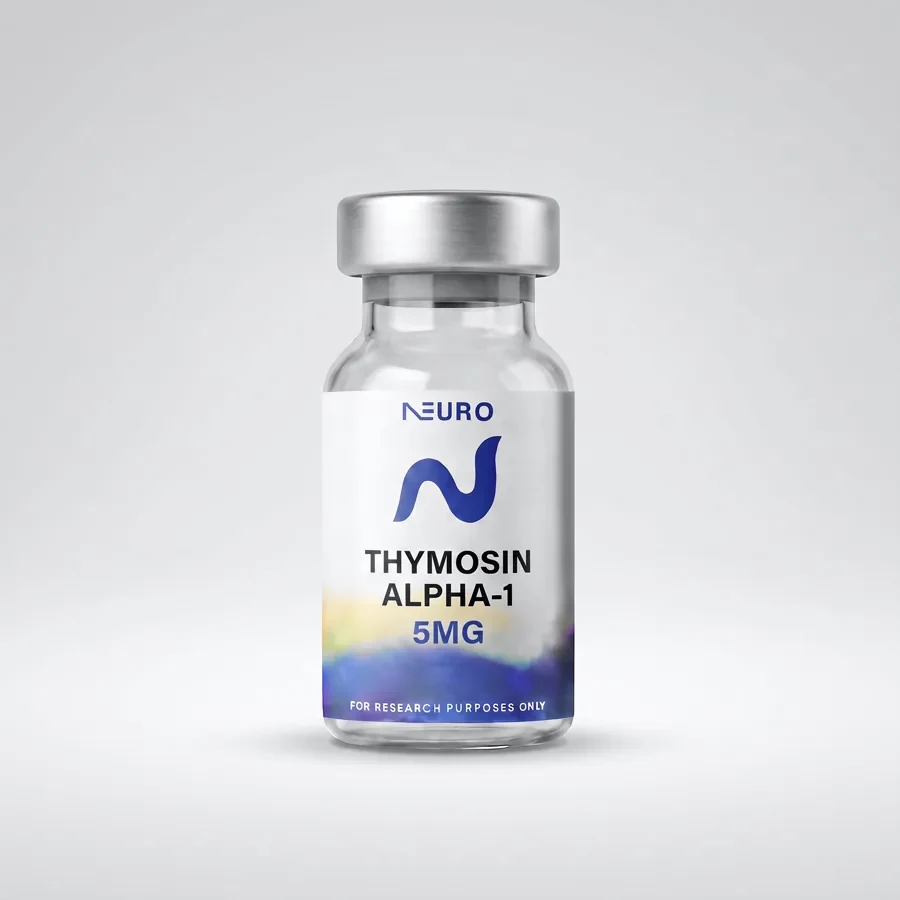
Sign in / Create accountResearchers looking to buy Thymosin Alpha-1 5mg can find research-grade, third-party tested Thymosin Alpha-1 at Neuro Peptides. Also known as Tα1 and thymalfasin, Thymosin Alpha-1 is a naturally occurring 28-amino-acid peptide that has been extensively investigated for its role in immune signaling and the regulation of innate and adaptive immune responses.
Thymosin Alpha-1 was originally identified as a biologically active component of thymic preparations. Research has since explored its interactions with dendritic cells, T lymphocytes, natural killer cells, Toll-like receptor signaling, cytokine production, and antigen presentation.
These characteristics make Tα1 an important research peptide for laboratory investigations involving immunology, molecular signaling, immune-cell communication, and thymic peptide biology.
Neuro Peptides supplies Thymosin Alpha-1 5mg as a lyophilized research peptide with third-party testing and batch-specific Certificate of Analysis documentation available.
5mg | Third-Party Tested | COA Available | Lyophilized | Research Use Only
Thymosin Alpha-1 5mg is intended strictly for laboratory research and is not intended for human or veterinary use.
Thymosin Alpha-1 is a naturally occurring acetylated peptide consisting of 28 amino acids.
It is derived biologically from prothymosin alpha and was initially identified through research involving thymic peptide fractions. The synthetic form of Thymosin Alpha-1 is commonly known as thymalfasin.
Its sequence is:
Ac-Ser-Asp-Ala-Ala-Val-Asp-Thr-Ser-Ser-Glu-Ile-Thr-Thr-Lys-Asp-Leu-Lys-Glu-Lys-Lys-Glu-Val-Val-Glu-Glu-Ala-Glu-Asn-OH
One notable structural characteristic of Thymosin Alpha-1 is the acetylated serine residue at its N-terminus.
Scientific research has focused extensively on its interactions with cells and signaling pathways involved in immune regulation, particularly dendritic cells, T lymphocytes, macrophages, natural killer cells, Toll-like receptors, and cytokine-associated pathways.
Because it can influence several interconnected immune processes, Thymosin Alpha-1 continues to be investigated as an experimental model for understanding communication between innate and adaptive immune systems.
| Specification | Details |
|---|---|
| Product Name | Thymosin Alpha-1 5mg |
| Full Name | Thymosin Alpha-1 |
| Synonyms | Tα1, Tα1, Thymalfasin |
| Quantity | 5 mg |
| Peptide Length | 28 amino acids |
| N-Terminus | Acetylated |
| Molecular Formula | C129H215N33O55 |
| Molecular Weight | 3108.3 g/mol |
| CAS Number | 62304-98-7 |
| PubChem CID | 16130571 |
| Appearance | White to off-white lyophilized material |
| Purity | Refer to batch-specific COA |
| Product Form | Lyophilized research peptide |
| Testing | Third-party tested |
| COA | Batch-specific Certificate of Analysis available |
| Intended Use | Laboratory research only |
| Human Use | Not intended for human use |
| Veterinary Use | Not intended for veterinary use |
The biological activity of Thymosin Alpha-1 is complex and cannot be described as the activation of a single receptor or signaling pathway.
Instead, research suggests that Tα1 can influence several components of immune signaling, including dendritic-cell activity, Toll-like receptor pathways, cytokine signaling, T-cell responses, and communication between innate and adaptive immune mechanisms.
This multi-pathway activity has made Thymosin Alpha-1 an important research molecule in immunology and molecular biology.
One of the most extensively studied areas of Thymosin Alpha-1 research involves Toll-like receptors, or TLRs.
TLRs are pattern-recognition receptors that allow immune cells to recognize molecular signals associated with microorganisms and cellular stress.
Experimental studies have linked Thymosin Alpha-1 activity with Toll-like receptor pathways in dendritic cells, including TLR2 and TLR9-associated signaling.
Activation of these pathways can involve downstream signaling proteins such as MyD88 and influence transcriptional mechanisms associated with immune-cell responses.
Because Toll-like receptors contribute to the recognition and coordination of innate immune signals, this pathway provides an important experimental framework for studying Thymosin Alpha-1.
Dendritic cells are professional antigen-presenting cells that form an important connection between innate immune recognition and adaptive immune responses.
Thymosin Alpha-1 has been investigated for its effects on both myeloid and plasmacytoid dendritic cells.
Research suggests that Tα1 can influence dendritic-cell maturation and signaling, which may subsequently affect antigen presentation, cytokine release, and communication with T lymphocytes.
The relationship between Thymosin Alpha-1 and dendritic-cell function is therefore one of the most significant areas of Tα1 research.
Toll-like receptor activation can recruit intracellular adaptor proteins, including myeloid differentiation primary response protein 88, commonly known as MyD88.
MyD88-dependent signaling can subsequently influence several intracellular pathways, including those involving NF-κB.
NF-κB is a transcriptional regulator involved in the expression of numerous genes associated with immune and inflammatory responses.
Researchers studying Thymosin Alpha-1 use these interconnected pathways to investigate how peptide-mediated signals may alter immune-cell communication and gene expression.
Cytokines are signaling molecules that allow immune cells to coordinate their activities.
Experimental research on Thymosin Alpha-1 has examined its relationship with several cytokines and cytokine-associated pathways.
Studies have reported effects involving signaling associated with interferons, interleukins, and other immune mediators under different experimental conditions.
These effects are dependent on factors such as the cell type, biological model, concentration, and experimental environment.
For this reason, Thymosin Alpha-1 should be studied as a modulator of complex immune signaling rather than as a peptide producing one universal cytokine response.
Thymosin Alpha-1 has historically attracted attention because of its relationship with thymic biology and T-cell function.
Experimental investigations have explored its influence on T-cell maturation, activation, differentiation, and signaling.
Researchers may use Tα1 in appropriately designed models to investigate how peptide-mediated signals affect T-cell-associated immune processes.
Natural killer cells are components of the innate immune system involved in recognizing and responding to abnormal or infected cells.
Thymosin Alpha-1 has been investigated for its potential influence on NK-cell activity and immune-cell communication.
This makes NK-cell biology another relevant area for controlled laboratory investigation of Tα1.
Innate immunity represents the body’s rapid recognition system for biological signals.
Research involving Thymosin Alpha-1 has examined several important components of innate immunity, including:
The effects observed in experimental systems suggest that Tα1 may influence the way innate immune cells detect signals and communicate with other components of the immune system.
However, individual experimental findings depend heavily on the model being studied and should not be generalized beyond the relevant research conditions.
Adaptive immunity involves highly specific responses mediated primarily through lymphocytes.
Thymosin Alpha-1 has been studied extensively in relation to T-cell biology and the communication between antigen-presenting cells and lymphocytes.
Dendritic cells can present antigens to T cells, meaning that modulation of dendritic-cell function may subsequently influence adaptive immune responses.
This relationship provides researchers with an experimental model for examining how signals originating within innate immune pathways can influence downstream adaptive immune activity.
Thymosin Alpha-1 5mg may be used in appropriately designed laboratory studies across several scientific fields.
Tα1 is investigated in studies involving innate and adaptive immune signaling, dendritic-cell activity, T-cell biology, NK cells, cytokine communication, and antigen presentation.
Researchers may investigate the relationship between Thymosin Alpha-1 and Toll-like receptor-associated signaling, including pathways involving MyD88 and downstream transcriptional responses.
Tα1 provides an experimental tool for studying dendritic-cell maturation, signaling, antigen presentation, and communication with other immune cells.
Researchers can examine how Thymosin Alpha-1 influences cytokine-associated signaling under controlled experimental conditions.
Thymosin Alpha-1 is relevant to laboratory investigations involving T-lymphocyte maturation, activation, differentiation, and cellular communication.
Tα1 can be used in studies examining gene expression and intracellular pathways associated with immune-cell signaling.
Laboratory studies may investigate peptide-mediated cellular responses, receptor-associated signaling, and interactions between different immune-cell populations.
Researchers may examine the molecular characteristics, concentration-dependent responses, and biological activity of Thymosin Alpha-1 in validated experimental systems.
Because Thymosin Alpha-1 was originally identified through thymic peptide research, it remains relevant to investigations examining the biological characteristics and functions of thymus-associated peptides.
Neuro Peptides provides third-party tested Thymosin Alpha-1 5mg for laboratory research.
Independent analytical testing gives researchers additional information about important characteristics of the supplied material and allows product specifications to be evaluated independently of the supplier’s internal quality-control process.
Researchers should review the testing documentation associated with the specific batch used in their experiments.
A batch-specific Certificate of Analysis is available for Thymosin Alpha-1 5mg supplied by Neuro Peptides.
Depending on the analytical testing performed, the COA may provide information such as:
Researchers should always use the COA corresponding to their specific batch rather than relying exclusively on general specifications listed on the product page.
High-performance liquid chromatography and mass spectrometry are commonly used analytical techniques in peptide quality assessment.
HPLC can be used to evaluate chromatographic purity by separating components present in a peptide sample.
The resulting chromatogram provides researchers with information about the relative proportions of detectable components under the specific analytical conditions used.
Mass spectrometry can provide information about molecular mass and help support confirmation of peptide identity.
When both HPLC and mass spectrometry results are available, researchers can evaluate different aspects of the material rather than relying on a single analytical measurement.
Batch-specific analytical documentation should always take priority over generalized product-page claims.
Appropriate storage is important for maintaining the integrity of Thymosin Alpha-1 during laboratory research.
Keep unopened Thymosin Alpha-1 5mg tightly sealed and protected from:
For long-term laboratory storage, frozen conditions such as approximately -20°C are commonly used for lyophilized Thymosin Alpha-1 preparations.
However, researchers should follow the storage conditions provided with the specific product and applicable batch documentation.
Thymosin Alpha-1 5mg supplied by Neuro Peptides is intended strictly for laboratory and scientific research.
It is not intended for human consumption, administration, diagnosis, treatment, disease prevention, veterinary use, or other clinical applications.
Neuro Peptides research materials are not marketed as pharmaceutical drugs, foods, nutritional supplements, cosmetics, or medical devices.
Thymosin Alpha-1 5mg is a research preparation containing the 28-amino-acid peptide Thymosin Alpha-1, also known as Tα1 or thymalfasin.
It is supplied by Neuro Peptides as a lyophilized research material for controlled laboratory investigation.
Thymosin Alpha-1 consists of 28 amino acids and has an acetylated N-terminal serine residue.
Thymalfasin is the name commonly used for the chemically synthesized form of Thymosin Alpha-1 corresponding to the naturally occurring peptide sequence.
Thymosin Alpha-1 is studied in areas including immunology, dendritic-cell biology, Toll-like receptor signaling, cytokine research, T-cell function, NK-cell activity, antigen presentation, and communication between innate and adaptive immune pathways.
Yes. Neuro Peptides Thymosin Alpha-1 5mg is third-party tested. Researchers can review available batch-specific analytical documentation associated with the supplied material.
Yes. Neuro Peptides provides a Certificate of Analysis for Thymosin Alpha-1 5mg. Researchers can review batch-specific analytical information before incorporating the product into laboratory experiments.
Testing documentation may include analytical techniques such as HPLC and mass spectrometry, depending on the specific batch.
Researchers should consult the batch-specific COA for the exact methods and results associated with their product.
The molecular weight of Thymosin Alpha-1 is approximately 3108.3 g/mol.
A commonly referenced CAS number for Thymosin Alpha-1/thymalfasin is 62304-98-7.
The sequence is:
Ac-Ser-Asp-Ala-Ala-Val-Asp-Thr-Ser-Ser-Glu-Ile-Thr-Thr-Lys-Asp-Leu-Lys-Glu-Lys-Lys-Glu-Val-Val-Glu-Glu-Ala-Glu-Asn-OH.
Yes. Neuro Peptides supplies Thymosin Alpha-1 5mg as a lyophilized research peptide.
Keep lyophilized Thymosin Alpha-1 protected from moisture, light, heat, and unnecessary temperature fluctuations. Approximately -20°C is commonly used for longer-term frozen storage of comparable research preparations, but researchers should follow the product-specific storage documentation provided with their batch.
Neuro Peptides orders typically arrive within 3–5 business days, depending on the destination, processing requirements, and selected shipping service.
Researchers can buy Thymosin Alpha-1 5mg from Neuro Peptides for laboratory research. The product is supplied in lyophilized form with third-party testing and batch-specific COA documentation available.
No. Thymosin Alpha-1 5mg supplied by Neuro Peptides is intended strictly for scientific and laboratory research and is not intended for human or veterinary use.
Thymosin Alpha-1 5mg is a well-characterized 28-amino-acid research peptide with extensive scientific literature examining its relationship with immune regulation and cellular signaling.
Research has focused particularly on dendritic cells, Toll-like receptors, MyD88-associated pathways, cytokine signaling, T-cell biology, natural killer cells, antigen presentation, and communication between innate and adaptive immune mechanisms.
These characteristics make Thymosin Alpha-1 relevant to a broad range of experimental investigations in immunology, molecular biology, cell biology, and peptide research.
Neuro Peptides supplies third-party tested Thymosin Alpha-1 5mg as a lyophilized research material with batch-specific Certificate of Analysis documentation available.
For laboratory research only. Not intended for human or veterinary use.
Every batch of Buy Thymosin Alpha-1 5mg is independently tested by an accredited third-party laboratory. The certificate below is the lot record for Buy Thymosin Alpha-1 5mg 5 mg.

| Test | Method | Result | Specification | |
|---|---|---|---|---|
| Identity | HPLC-DAD | Thymosin Alpha-1 | Thymosin Alpha-1 | Pass |
| Purity | HPLC-DAD | 99.75 | >99% by HPLC | Pass |
| Quantity | HPLC Analyte Concentration Curve Assay | 4.98mg | 5mg | Pass |
| Endotoxins | LAL ELISA | 0.223 EU/mL | ≤ 0.5 EU/mL | Pass |
| Sterility | Pour Plate | No Growth | No Growth | Pass |

Full lot-specific COA documentation is available on request from our research support team.
Storage guidelines
Store at controlled room temperature Keep in original sealed container Do not freeze the vials Maintain stable temperature conditions
Refrigerate immediately at 36°F to 46°F Store at 2°C to 8°C consistently Keep refrigerated between uses Place in clean refrigerator compartment
If left out for more than 4 hours, contact supervisor Do not use if the temperature exposure is exceeded Return to refrigerator promptly after use Monitor storage conditions regularly
Chemical properties